
Ships within 7-10 business days.
| Method | ELISA |
|---|---|
| Sample Type (Matrix) | Urine |
| Sample Volume | 50 µL |
| Species | Human |
| Incubation Time | Overnight |
| Range | 3-300 µmol/L |
| Size | 96 wells |
| Regulatory Status | For Research Use Only. Not for use in diagnostic procedures. |
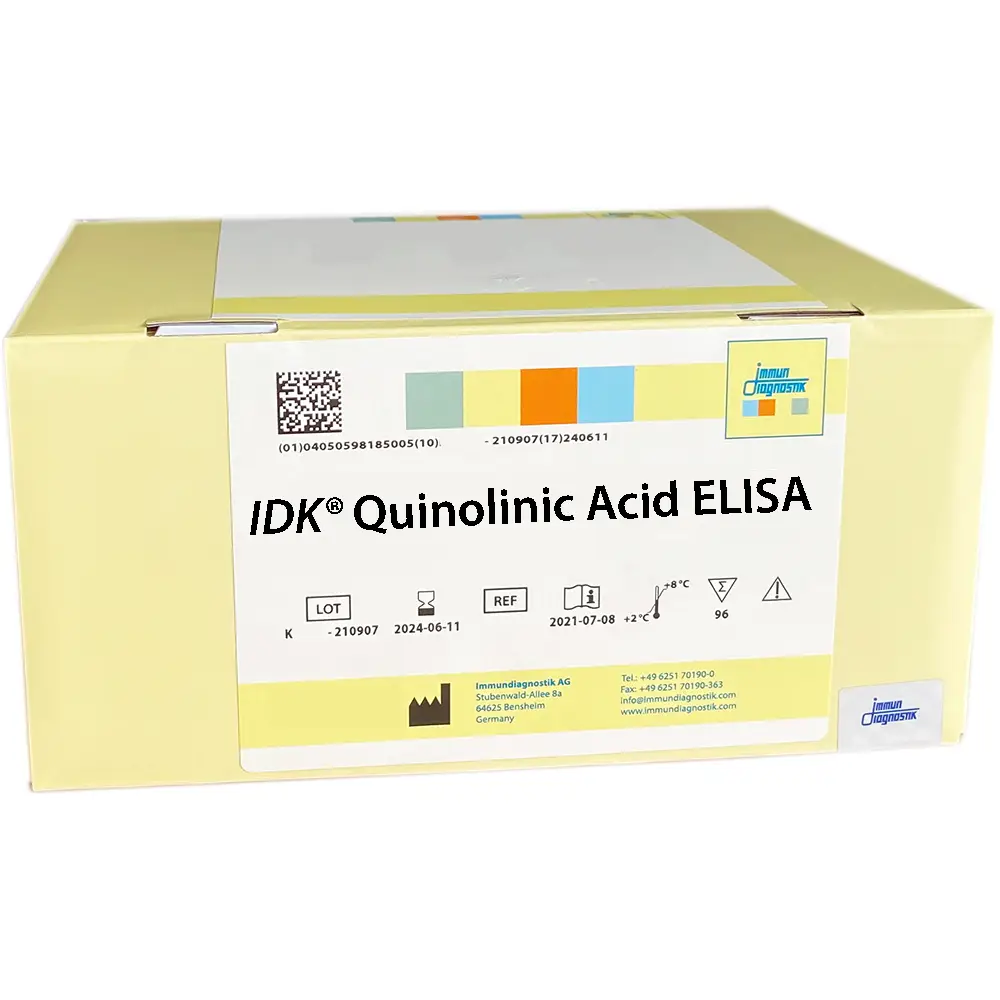
The IDK® Quinolinic Acid ELISA is intended for the quantitative determination of quinolinic acid (pyridine-2,3-dicarboxylic acid) in urine.
For research use only. Not for use in diagnostic procedures.
For Laboratory Professional Use Only.
This product requires a minimum quantity. Please contact us to get a quote.
Manufactured by Immundiagnostik AG.
The IDK® Quinolinic Acid ELISA is designed for the quantitative determination of quinolinic acid.
The assay is based on the method of competitive enzyme-linked immunoassays. Samples, standards, and controls are incubated in wells of a microtiter plate coated with quinolinic acid (antigen), together with a polyclonal anti-quinolinic acid antibody. The free target antigen in the sample competes with the antigen immobilized on the wall of the microtiter wells for the binding of the polyclonal antibodies.
In the second incubation step, a peroxidase-conjugated antibody is added to each microtiter well to detect the anti-quinolinic acid antibodies. After a washing step to remove the unbound components, the peroxidase substrate tetramethyl-benzidine (TMB) is added.
Finally, the enzymatic reaction is terminated by an acidic stop solution. The color changes from blue to yellow, and the absorbance is measured in the photometer at 450 nm. The intensity of the yellow color is inversely proportional to the quinolinic acid concentration in the sample. This means, high antigen concentration in the sample reduces the concentration of antibodies bound to the antigen on the plate and lowers the photometric signal.
A dose-response curve of the absorbance unit (optical density, OD at 450 nm) vs. concentration is generated, using the values obtained from the standards. The presence of quinolinic acid in the samples is determined directly from this curve.
Fill out the form to let us know how we can help you, and someone will be in touch with you soon.